
How Traders Are Using AI to Review 1,000 Trades Faster Than Ever
Trading results are not hidden in the charts. Instead, they are buried in records that are rarely reviewed. Over time, every trade leaves behind data, yet most of it remains disconnected from any real analysis.
As a result, performance becomes difficult to evaluate beyond short-term outcomes or isolated wins and losses. This gap between “data collection” and “data interpretation” is where artificial intelligence (AI) begins to change the process.
By using AI, traders can now organize historical data and spot complex patterns. Usually, this is done through AI trade review and trade analysis with AI. Read this article to learn how trading data becomes more powerful through analysis, how patterns emerge from large samples, and how AI supports a deeper trading performance review.
Most Traders Are Sitting on a Gold Mine of Untapped Data
Most active traders already create a large amount of valuable trading data. Every executed trade, chart screenshot, journal entry, broker statement, replay session, and setup review adds another piece to a growing performance history. As a result, there is usually no shortage of information.
However, collecting data alone does not improve trading results. In many cases:
- Screenshots remain stored for months without review
- Journal entries receive only occasional attention, and
- Broker reports are used only to check basic metrics like win rate.
Consequently, much of the available information remains unused. This is where a “trade review” process becomes important. A detailed trading performance review examines the entire trading history rather than individual trades in isolation. Therefore, recurring patterns become easier to identify. For example, historical data may reveal:
- Which setups deliver the best results
- Which market conditions produce consistent profits, or
- Which repeated mistakes lead to unnecessary losses.
An AI trading journal can add another layer of analysis. It can:
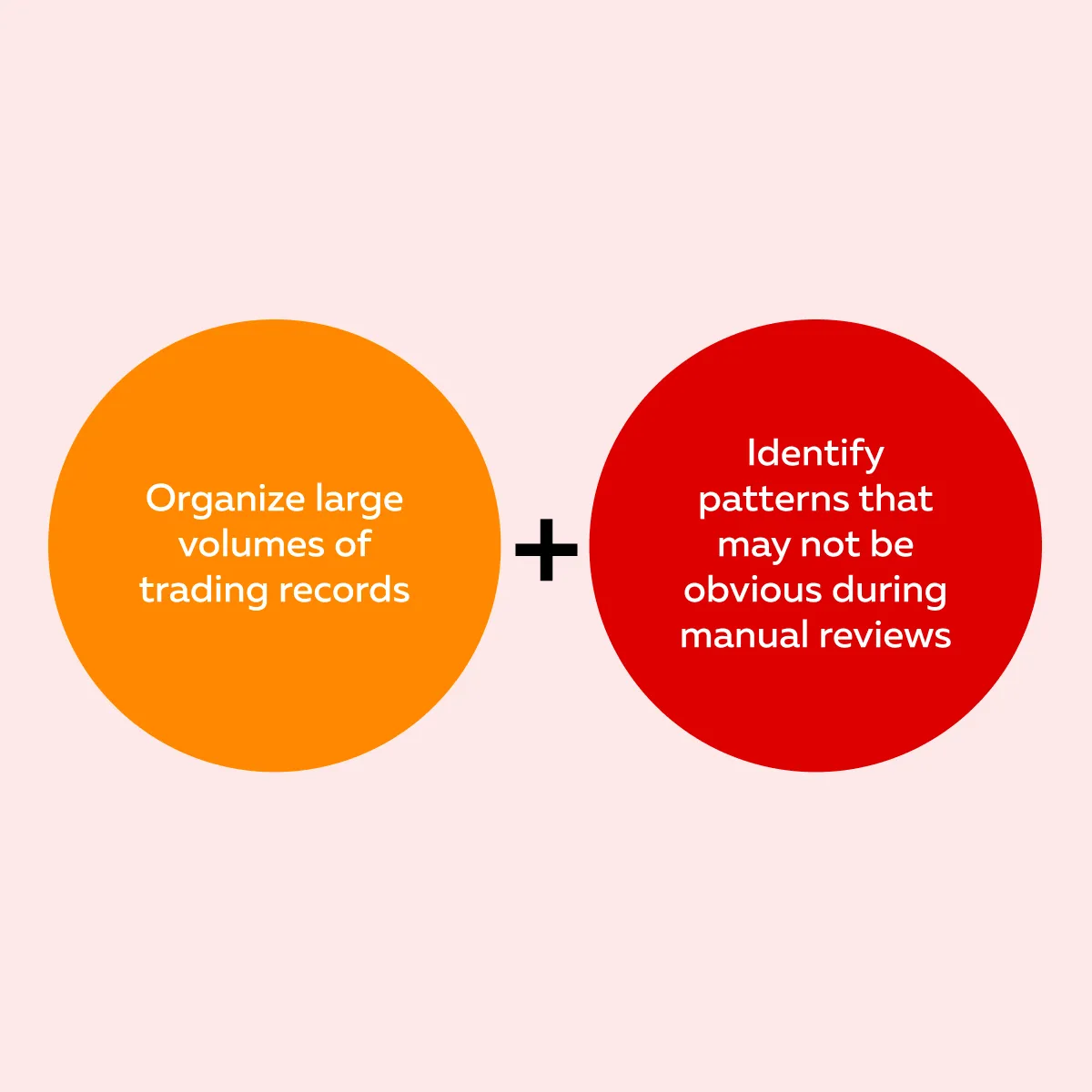
In other words, the real challenge for many traders is not a lack of data but a lack of analysis. That is why AI for traders has become valuable, as it helps turn existing trading records into practical insights instead of leaving them unused. Learn how the Bookmap Trading Journal helps traders organize and review their performance.
Why Reviewing 1,000 Trades Tells a Different Story Than Reviewing 10
One of the most common mistakes in trading is drawing conclusions from a small number of trades. For instance, three winning trades may create the impression that a strategy always works, while five losing trades may lead to the belief that the strategy has failed. However, market outcomes over small samples are usually influenced by chance rather than true performance.
In contrast, a trading performance review based on hundreds or thousands of trades presents a more accurate picture. Larger datasets reduce the impact of random results and reveal patterns that remain hidden in small samples. As a result:
- Traders can separate luck from skill, and
- Temporary market conditions from genuine strategy strengths or weaknesses.
For example, a trader may believe that breakout trades do not work. However, AI-driven trade analysis may reveal that breakout setups perform well during the first two hours of the trading session but lose effectiveness later in the day.
Therefore, reviewing a large trading history usually challenges long-held assumptions. Instead of relying on recent outcomes, an AI trading journal can spot patterns, leading to more accurate conclusions about trading performance.
What AI Can Find in Minutes That Might Take Humans Weeks
The primary strength of AI for traders is not making trading decisions. Instead, it can analyze large amounts of information. While human traders can review charts and journals one by one, AI can:
- Examine thousands of records at the same time, and
- Identify relationships that are difficult to notice through manual review.
As a result, trade analysis with AI can reveal patterns across many areas of trading. These may include the following:
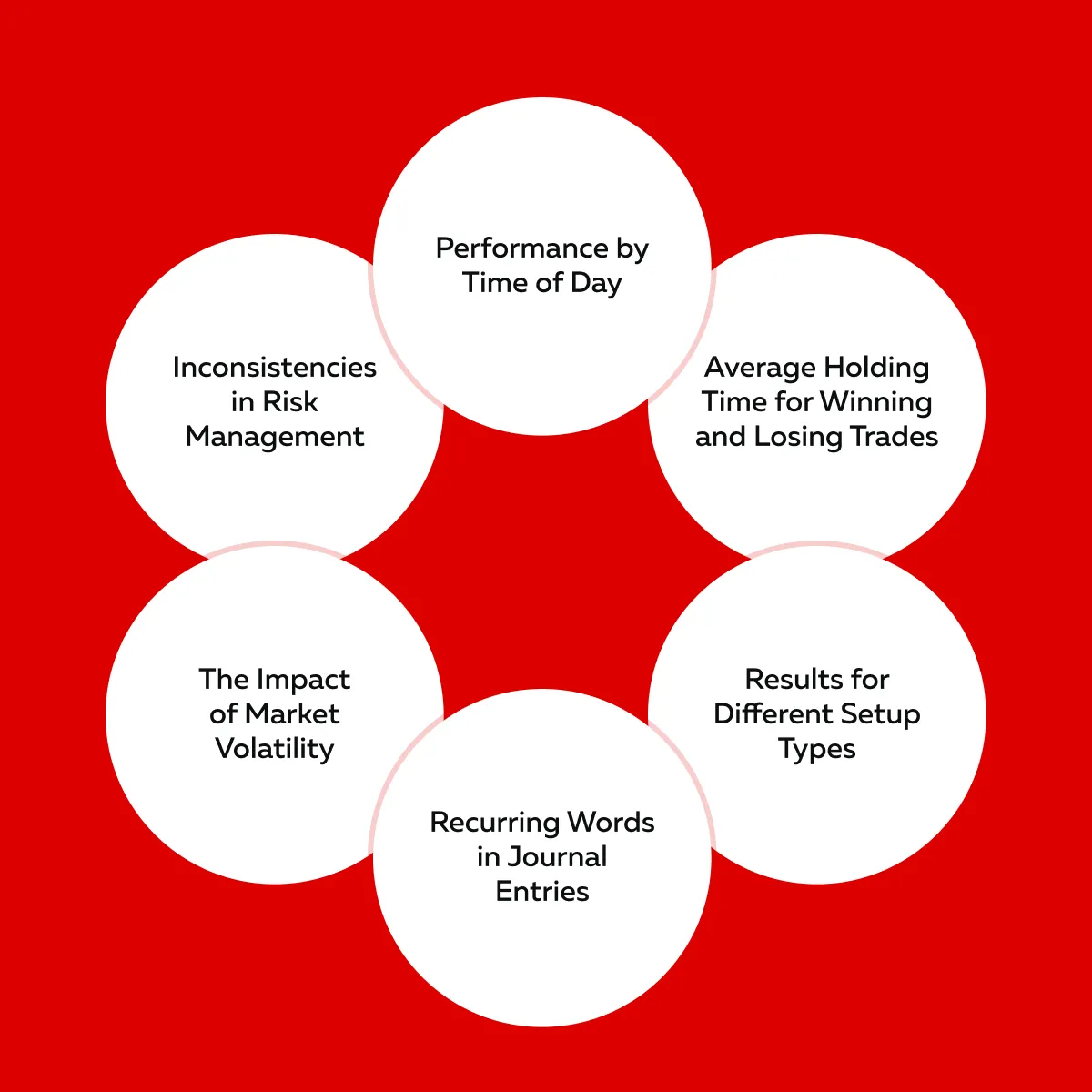
For example, an AI trading journal may analyze hundreds of journal notes and find that the word “hesitated” appears frequently before losing trades. Similarly, an AI trade review may show that most losses occur after the third trade of a session.
Therefore, AI should be viewed as a “pattern discovery tool” rather than a prediction tool. Instead of forecasting the next winning trade, it could be used to examine historical trading data and connect related information.
The Trading Journal Is Evolving
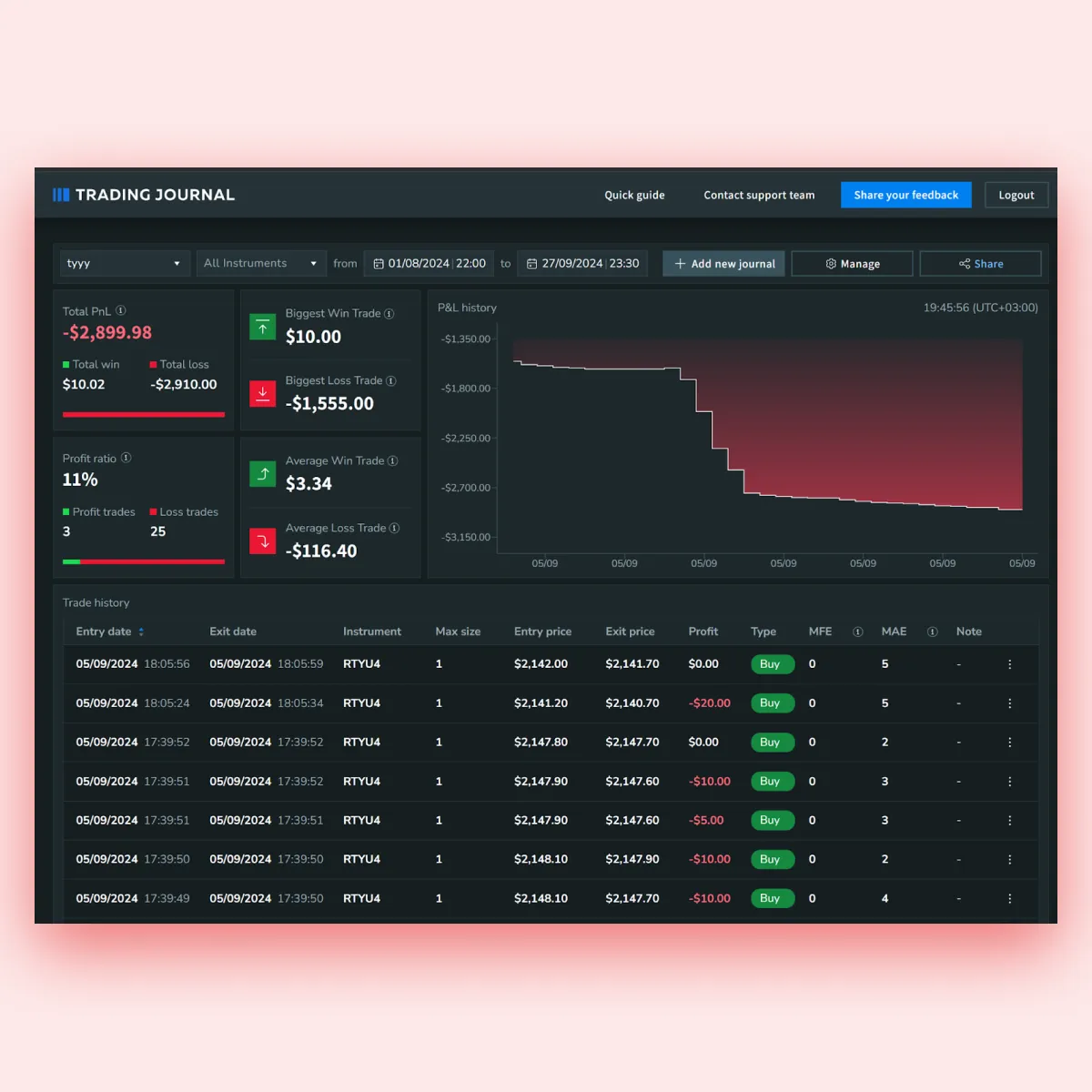
Traditional trading journals mostly served as storage systems. Traders recorded trade details, and those records were only reviewed from time to time. As a result, much of the collected information remained unused.
However, modern journals function as searchable databases instead of simple notebooks. In addition to recording trades, many traders now:
- Tag setup types
- Save chart screenshots
- Grade execution quality, and
- Note the market context behind every position.
Consequently, each trade contains much richer information for future analysis. This detailed record becomes even more useful when combined with an AI trading journal. Instead of reading entries one by one, AI can:
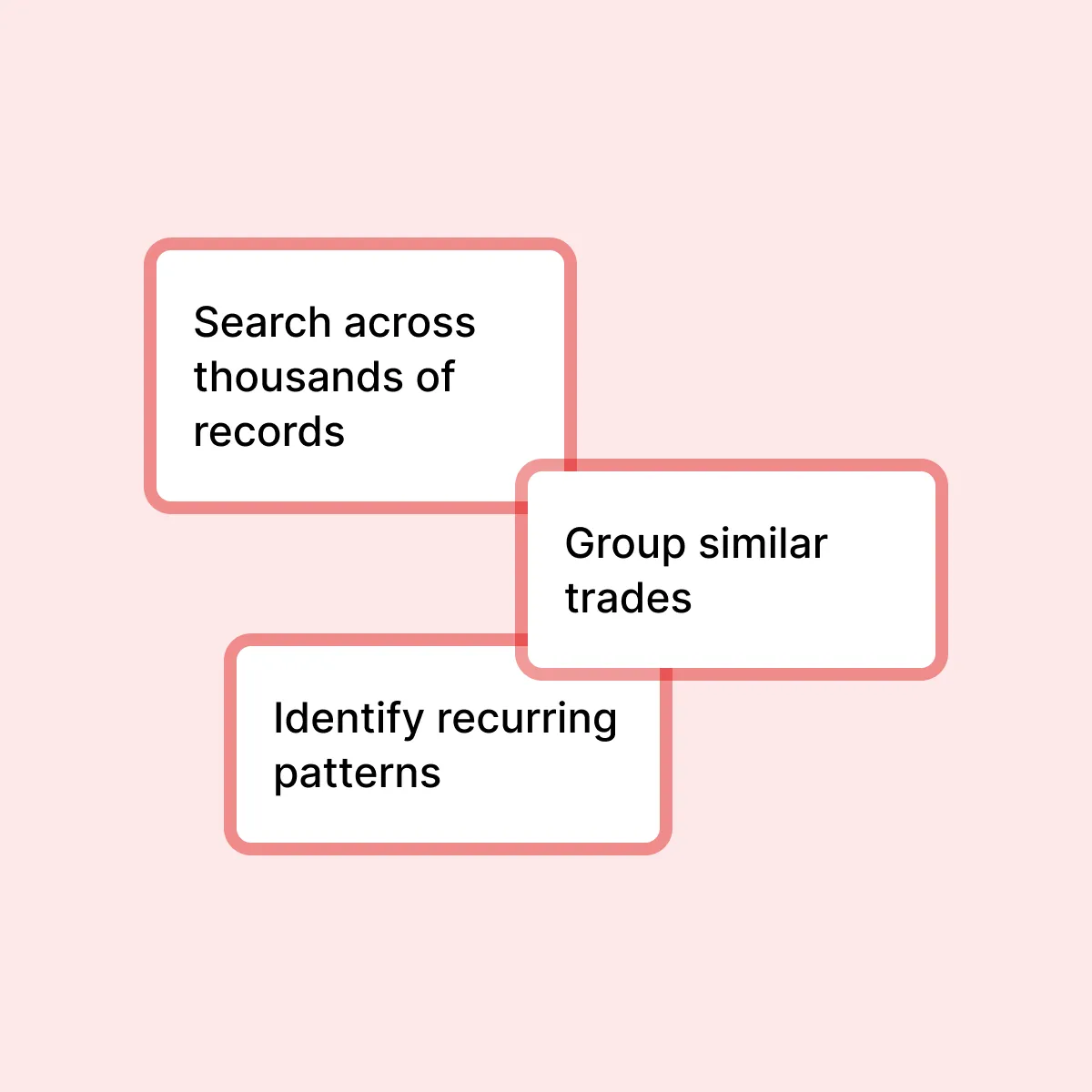
Therefore, the journal changes from a historical record into an active tool for trade analysis with AI and long-term trading performance review.
What is Bookmap Trading Journal?
The Bookmap Trading Journal allows traders to organize and manage trading records in a structured format. When information is properly categorized and searchable, an AI trade review can examine trading history in greater depth and uncover insights that may remain hidden in manual reviews.
For traders interested in learning more about its features and workflow, the Bookmap Trading Journal Knowledge Base provides detailed documentation.
Note that a modern trading journal is no longer just a place to record what happened. Instead, it has now become a valuable resource for:
- Discovering patterns
- Evaluating trading decisions, and
- Supporting continuous improvement over time.
Combine detailed trade records with Bookmap’s replay and visualization tools to improve your review process.
Building a Personal Trading Database
Professional performance environments show a consistent pattern of tracking.
- Sports teams record every action
- Poker professionals document every decision, and
- Businesses maintain detailed operational data.
In contrast, trading behavior largely remains dependent on memory, limiting the ability to evaluate performance with depth and accuracy. To remove such issues, most traders maintain a personal trading database. This database usually includes the following:
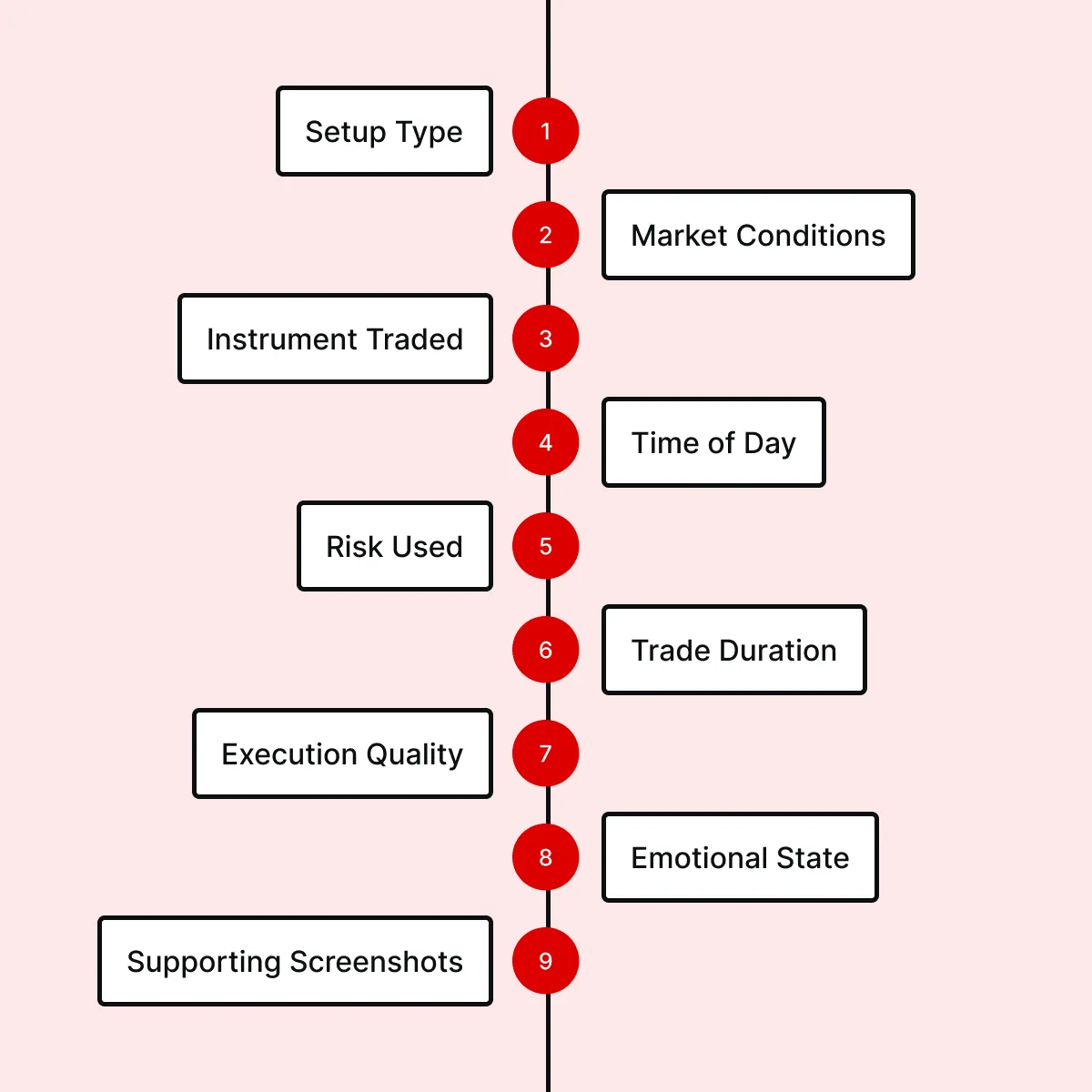
Consequently, each trade becomes a “data point” within a larger performance system. The value of this database increases over time as it grows and becomes cleaner. In this context, an AI trading journal can process organized records and identify recurring patterns across similar trade conditions.
Importantly, this approach does not require complex systems or advanced tools. Instead, it depends on consistent record-keeping that captures trade information in a repeatable format. Note that the efficiency of trade analysis with AI may increase only when the deployed model uses organized historical data rather than fragmented or incomplete records.
Why AI Still Needs Human Context
Modern analysis tools create strong expectations around automation. However, limitations remain in interpretation. AI can identify statistical patterns across trading data, yet it cannot fully interpret real-time market context. Let’s check out some of its limitations:
- It does not observe what was visible on the chart during execution.
- It cannot reconstruct the decision environment with complete accuracy.
- AI cannot consistently separate a good decision from a favorable outcome
Additionally, a trade may produce a profit or a loss, but AI cannot accurately determine the reason or cause of the action. Let’s understand better through an example:
- Suppose an AI trade review highlights that losses concentrate in breakout trades.
- However, the underlying cause still requires investigation.
- The potential reasons may include:
- Chasing entries
- Unsuitable market conditions
- Weak risk management, or
- Changes in market regime.
- AI models cannot yet identify the underlying cause precisely.
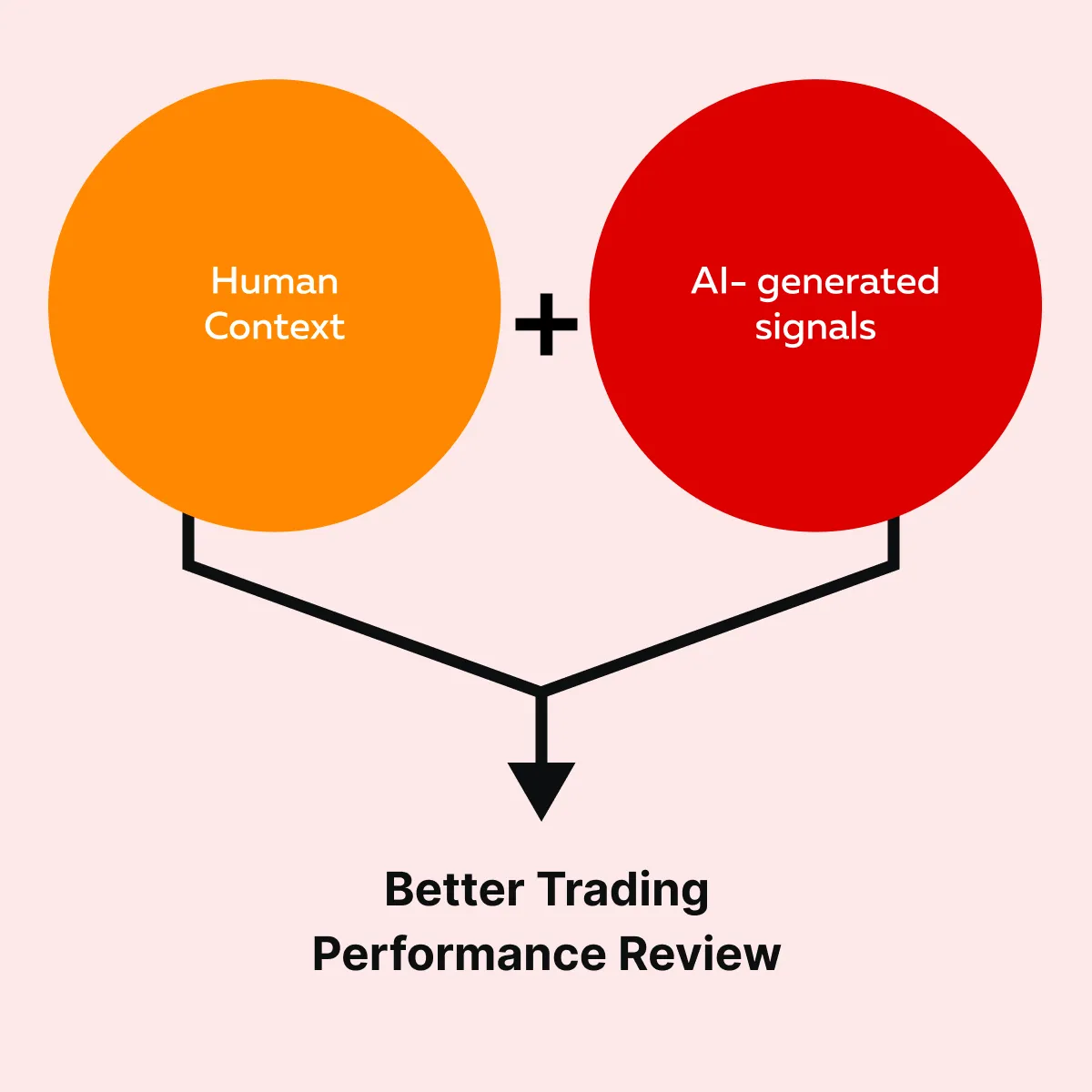
Consequently, AI functions primarily as a “pattern detection layer” within AI trade analysis, while interpretation remains a separate analytical step. Nowadays, several traders also prefer a “hybrid approach” as follows:
Conclusion
For many years, trading performance data has existed in large volumes, yet most of it has remained underused due to limited review methods. With the rise of AI for traders, this situation is changing. Through AI trade review and trade analysis with AI, large datasets can now be examined to reveal recurring patterns, strengths, and weaknesses that are not visible through basic observation.
As a result, a more complete trading performance review becomes possible based on evidence (rather than short-term impressions). Note that the objective is not to predict future outcomes but to evaluate past behavior at scale.
In this context, an AI trading journal supports deeper learning by organizing and analyzing trade history. Store, review, and analyze your trades with the Bookmap Trading Journal.
FAQ
1. Can AI analyze my trading journal?
Yes, an AI trading journal can analyze journal entries, trade notes, screenshots, and performance records. Through trade analysis with AI, recurring patterns across winning and losing trades can be identified, such as:
- Repeated mistakes
- Consistent setups, or
- Performance differences across market conditions.
As a result, trading history becomes a “source of insights” rather than isolated records.
2. How many trades should I review before making changes to my strategy?
There is no fixed number that defines when changes should be made. However, larger datasets provide more stable conclusions in a trading performance review. When hundreds of trades are included, patterns linked to skill, setup quality, and market behavior become more visible. At the same time, short-term randomness becomes less influential.
Therefore, broader samples may support a more reliable evaluation of strategy performance.
3. What information should I track in a trading journal?
As per general market understanding, a trading journal may include:
- Setup type
- Entry and exit details
- Market conditions
- Instrument traded
- Time of day
- Risk management decisions
- Trade duration
- Execution quality
- Screenshots, and
- Notes related to emotions or decision-making context
This level of detail allows an AI trading journal to perform deeper analysis and supports more complete trade analysis with AI across different trading conditions.
4. Can AI tell me which strategy is best?
AI can evaluate historical trading data and highlight which strategies have shown stronger performance patterns over time. Through an AI trade review, it can compare setups, outcomes, and conditions to identify relative strengths and weaknesses.
However, final interpretation remains necessary because market context, regime changes, and execution behavior affect outcomes beyond statistical results alone.
5. How does the Bookmap Trading Journal help traders?
The Bookmap Trading Journal helps organize trades by recording performance data, screenshots, and trade notes. The database so created supports long-term trading performance review and enables more effective use of AI for traders.
Over time, it becomes a “searchable system” for evaluating trading behavior and identifying consistent patterns across market conditions.
 Twitter
 Facebook