
If You Can’t Explain Your Edge, You Probably Don’t Have One

Many traders spend years searching for the perfect setup. They believe that the next indicator, pattern, or strategy will solve their trading problems. However, a setup alone is not enough. A lasting market edge comes from knowing why a trade has a statistical advantage and which market conditions support it.
Without that foundation, even a profitable strategy can lose credibility after a few losing trades. This is why successful trading is built on more than recognizing patterns. It depends on market behavior, probability, and the forces that drive price movement.
Read this article to learn what a trading edge is, how it differs from a setup, and where a profitable trading edge comes from. Also, see how order flow reveals the reason behind market moves, and why continuous review and refinement are essential for long-term trading success.
A Setup and an Edge Are Not the Same Thing
One of the biggest misconceptions in trading is treating a chart pattern as a trading edge. In reality, a pattern only shows where a trader may enter or exit a trade. It does not explain why that trade has a higher probability of success. This is the key difference between a trading setup and an edge.
Note that a “setup” is the signal, such as a:
- Breakout
- Moving average crossover
- Support and resistance level, or
- Opening range break.
However, a market edge comes from the reason that the setup works under specific market conditions. For example, a breakout may succeed because traders caught on the wrong side are forced to exit their positions, new buyers or sellers enter the market, or liquidity around an important price level has already been absorbed.
Therefore, the pattern itself is not the profitable trading edge. The real edge lies in the market behavior behind the pattern. As a result, two charts may display the same setup but produce very different outcomes. Note that the difference is not the pattern but the context.
For more clarity, let’s check out some factors that show whether the setup has a genuine trading strategy edge:
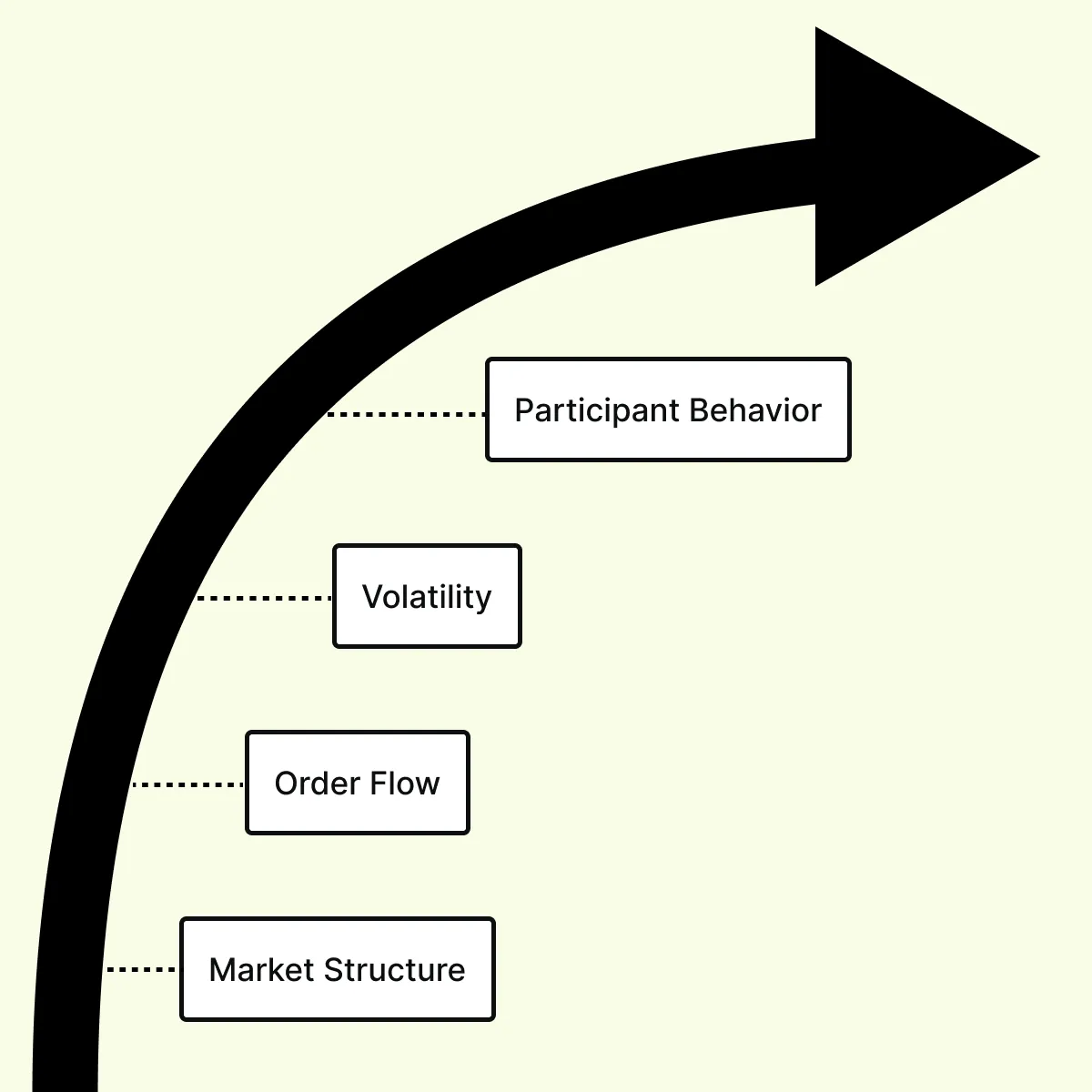
A simple comparison is poker. Holding a pair of aces is a strong starting hand, but it does not guarantee a win. The final result depends on the cards, the opponents, and the situation at the table.
Trading works in the same way. A setup creates an opportunity, but the edge comes from the conditions that make that opportunity statistically favorable.
Every Real Edge Comes From Some Form of Market Behavior
Financial markets are not random collections of price candles. Every price move is created by buyers and sellers with different goals, trading styles, and time horizons. Therefore, a genuine market edge may come from observing how these participants behave under different conditions.
Let’s understand better through two different examples of trading strategies:
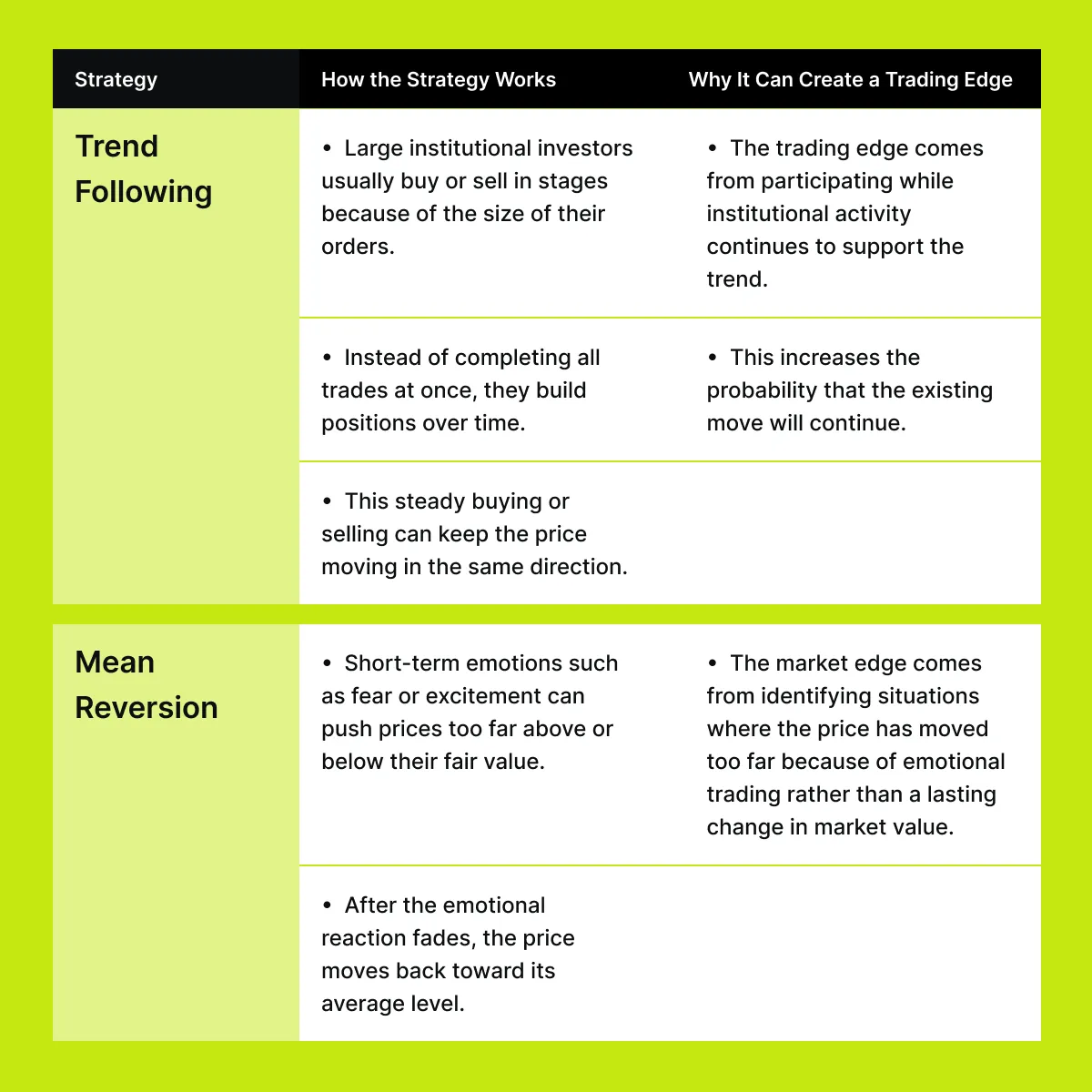
As a result, every profitable trading edge is built on a repeatable market behavior rather than a chart pattern alone. Markets do not reward traders simply for identifying chart patterns. Instead, a trading strategy edge may develop when recurring human behavior, institutional activity, or market structure creates a “statistical advantage”.
This is also the point where the way markets are analyzed begins to change. Instead of asking which pattern is forming, the analysis shifts toward questions such as:
- Which participants may be trapped
- Who is entering new positions
- Who is exiting existing trades, and
- Where liquidity is likely concentrated.
These recurring behaviors may create a lasting trading edge.
The Questions Every Trader Should Be Able to Answer
A trading edge is more than a set of entry and exit rules. Every trade should be supported by a non-ambiguous reason based on market behavior rather than a chart pattern alone. A trading strategy edge can be evaluated by asking a few important questions:
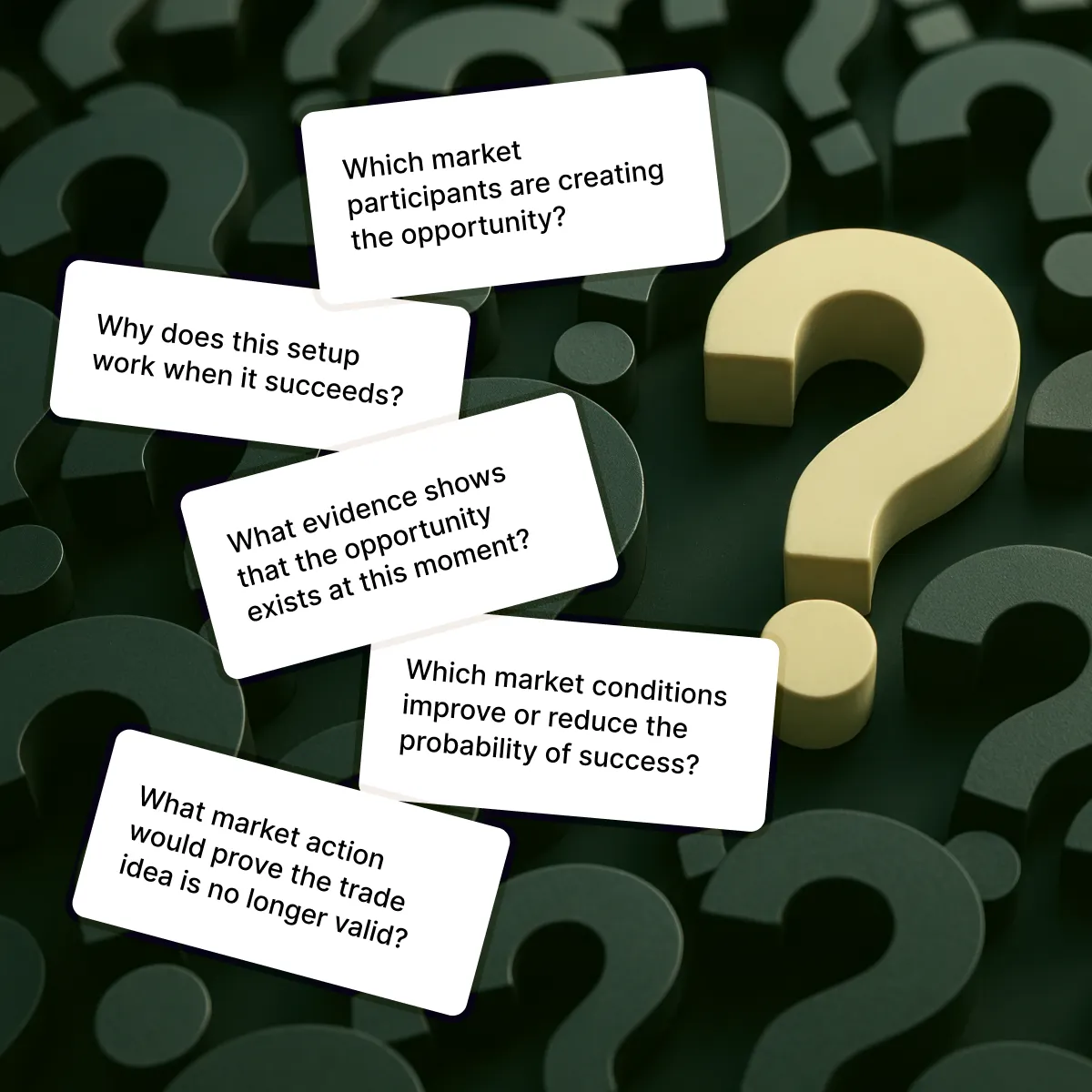
These questions help separate a genuine market edge from simple pattern recognition. If the answers are unclear, the setup may be more based on familiar chart shapes than on repeatable market behavior.
Here, the objective is not to create technical or academic explanations. Instead, the goal is to confirm that the profitable trading edge is supported by:
- Observable market conditions
- Participant behavior, and
- Logical evidence (rather than hope or hindsight).
Many traders discover they don’t have a setup problem—they have a market understanding problem. Learn how Bookmap helps visualize what drives price.
Why Traders Lose Confidence in Strategies They Never Fully Understood
Many traders follow a common cycle. They discover a new setup, see a few winning trades, and believe they have found a profitable trading edge. However, after a series of losses, they abandon the strategy and begin searching for another one. As a result, the same cycle repeats.
Usually, this happens because the real trading edge was never clearly identified. When the reason behind a setup is unknown, every losing streak can appear to be proof that the strategy has stopped working.
In contrast, a trader with a genuine trading strategy edge recognizes that markets naturally go through changing conditions. This allows evaluating whether market behavior has actually changed or whether the losses are simply part of normal statistical variation.
This idea is closely linked to trading expectancy. Even strategies with a positive expectancy experience losing trades and periods of drawdown. Therefore, short-term losses do not automatically mean that the market edge has disappeared.
For this reason, confidence does not come from a series of winning trades. Instead, it comes from knowing:
- Why the trading strategy works
- What market behavior supports it, and
- When the conditions behind that edge are still present.
How Order Flow Helps Traders Understand the “Why”
Traditional price charts show what happened in the market, such as where the price moved and where it stopped. However, they do not explain why those moves occurred. This is where order flow provides additional insight into the market edge behind a trade.
What Does Order Flow Show?
Order flow reveals how buyers and sellers interact in real time. Generally, it shows the following:
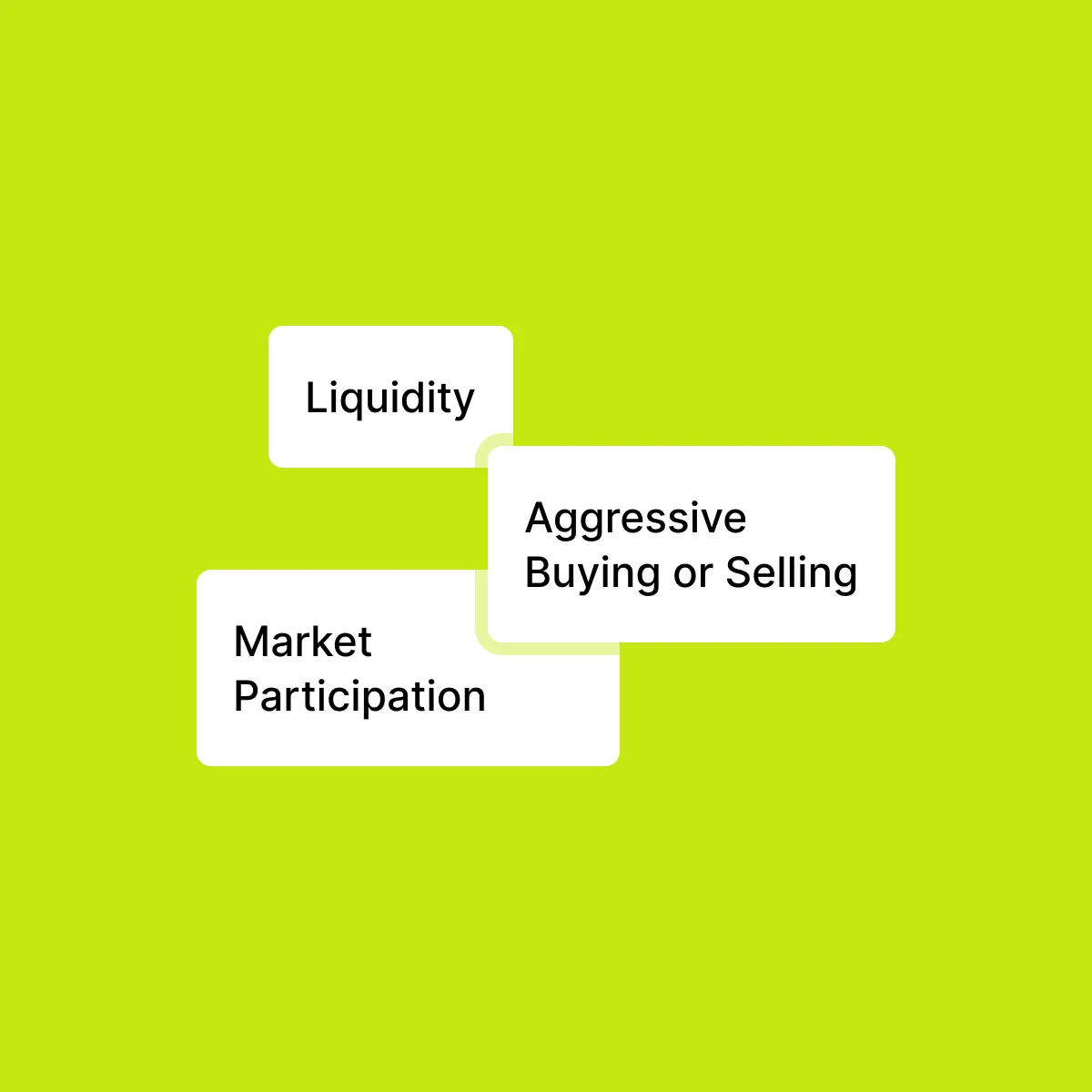
As a result, the reason behind a trading edge is more visible than just chart patterns alone. For example, a breakout may occur because:
- Aggressive buyers are lifting sell orders
- Stop-loss orders above resistance are being triggered
- Sell-side liquidity is disappearing, and
- New market participants are entering with strong buying interest.
Similarly, a reversal may occur because large orders absorb incoming buying or selling pressure, momentum begins to fade, or fewer participants continue to support the existing move. Now, the reason behind these market behaviors can be determined through order flow analysis. It can show:
- Where trades are executed
- Where liquidity is added or removed, and
- How buyers and sellers interact at important price levels.
It may also show whether price moves are supported by genuine buying or selling interest or are simply the result of a short-term liquidity event. This deeper view of market behavior can make it easier to identify and validate a profitable trading edge.
Developing an Edge Requires Structure, Feedback, and Review
One of the biggest myths in trading is that successful traders eventually discover one perfect setup that keeps working forever. In reality, a lasting trading edge is usually built through observation, testing, trade review, and continuous refinement. Let’s understand in detail:
Building a Trading Edge Is an Ongoing Process
Most traders begin with a simple idea or chart pattern. For example, a trendline break may appear to produce strong price moves. However, over time, repeated analysis may reveal that the setup performs better only under certain conditions, such as aggressive buying or favorable liquidity conditions. As a result, the pattern evolves into a trading strategy edge based on repeatable market behavior.
However, this process cannot be done without the “right” feedback. Many traders review the wrong factors, draw incorrect conclusions from results, or repeat the same execution mistakes without noticing them. Such a substandard analysis leads to the development of fragile trading setups.
Therefore, education and mentorship on regular trade reviews are highly important.
The Bruce Pringle’s Pilot Program

The Bruce Pringle’s Pilot Program is an educational initiative by Bruce Pringle, Chief Educator at Bookmap. This program places greater importance on developing a repeatable market edge than on teaching entry signals alone. The emphasis is on:
- Market structure
- High-probability conditions
- Trade planning
- Execution review, and
- The discipline required to apply a strategy consistently.
The objective is not to memorize trading setups. Instead, the goal is to learn why opportunities exist, what market behavior supports them, and how to execute them consistently. Through this approach, trade selection becomes more selective. Also, a trader’s confidence increases because decisions are supported by repeatable market behavior.
Want to develop a more structured understanding of market behavior? Explore Bruce Pringle’s Pilot Program
Conclusion
One of the biggest mistakes in trading is believing a strategy works without knowing why. While some setups may produce good results for a period of time, lasting success usually comes from a repeatable trading edge. Every sustainable edge is supported by market behavior, participant activity, and conditions that create a statistical advantage.
At the same time, traders may realize that markets involve uncertainty and that no strategy wins every trade. Even a profitable trading edge goes through losing streaks and drawdowns. However, traders who know the logic behind their trading strategy edge are better able to evaluate changing market conditions instead of abandoning a strategy after a few losses.
In the end, long-term progress comes from improving the quality of analysis and refining the edge over time. An edge is easier to understand when you can see how buyers, sellers, and liquidity interact in real time. Compare Bookmap packages.
FAQs
1. What is a trading edge?
A trading edge is a repeatable advantage that gives a trader a positive statistical expectation over many trades. Generally, it is created by:
- Market behavior
- Probability, and
- Disciplined execution.
A genuine profitable trading edge does not guarantee that every trade will succeed. Instead, it aims to produce positive results over a large sample of trades while managing risk.
2. Is a chart pattern the same as a trading edge?
No, a chart pattern is a setup, while a trading edge is the reason that setup has a statistical advantage. This is the main difference in the trading setup vs. the edge discussion. For example, a breakout pattern may appear on many charts. However, it becomes a trading strategy edge only when supported by market behavior, such as liquidity shifts, aggressive buying or selling, or changes in market participation.
3. How can I tell if I have a real edge?
A genuine market edge should be supported by logic and evidence rather than belief. There should be a valid explanation for:
- Why the setup works
- Which market participants create the opportunity, and
- Which conditions increase or reduce its probability of success?
In addition, results should be based on a broad sample of trades instead of a few recent winners. This helps separate a real trading edge from random outcomes.
4. Can an edge stop working?
Yes, markets are dynamic due to changing economic conditions, market participants, liquidity, and volatility. As a result, a trading strategy edge that performed well in one market environment may become less effective in another.
This is why successful traders regularly review their performance and evaluate whether the market behavior that supports their edge still exists. Continuous review helps refine a strategy instead of trading on outdated assumptions.
4. How does order flow help traders develop an edge?
Order flow provides insight into the activity behind price movements (rather than showing price alone). As per general market understanding, it reveals information such as:
- Liquidity
- Aggressive buying or selling
- Absorption, and
- Stop-loss activity.
As a result, traders can identify why a move is taking place rather than relying solely on chart patterns. This deeper view of market activity may build a stronger market edge and make it easier to identify the conditions that support a profitable trading edge.
 Twitter
 Facebook